
New type of plastic-degrading enzyme discovered in bacteria
In the ocean, plastic waste collects to form large garbage patches that endanger marine life. This is partly because the synthetic plastic polymers used today can only be broken down biologically, that is, by microorganisms, at a very slow rate. Instead, the physical fragmentation of these materials leads to the formation of microplastics and nanoplastics. However, microorganisms do colonize plastic waste in the environment, forming biofilms and creating a unique microbial habitat that researchers refer to as the ‘plastisphere’.
A research team at the University of Konstanz has now identified a new enzyme that can not only degrade certain polyesters and bioplastics, but also might provide bacteria with resistance to antibiotics. The discovery raises hopes that microorganisms can adapt to plastic degradation more rapidly than previously thought. Due to its structure featuring a wide-open active site, the researchers have named this ‘plastic-eating’ enzyme the ‘Pac‑Man enzyme’. Accelerating the environmental breakdown of plastic would require the use of biodegradable plastics wherever possible, as these materials can be decomposed by microorganisms.
The research project
In their research project, Harry Lerner (first author), a microbiologist and, at the time, postdoctoral researcher at the University of Konstanz, as well as David Schleheck, a professor of Microbial Ecology and Limnic Microbiology, investigated the complete microbial degradation of bioplastics. At the same time, they analyzed both the composition and the complete genetic makeup (the metagenome) of the microbial community involved in this degradation. For the study, the researchers used bioplastic materials – long-chain aliphatic polyesters (LCAP) – developed by Stefan Mecking's team, a professor of Chemical Materials Science at the University of Konstanz. Their joint study has now been published in the renowned scientific journal The ISME Journal.
"The plastisphere is a new habitat in our environment. Humans have only been introducing plastic into the environment in significant quantities for around 50 to 75 years. Since then, it has theoretically been available to microbial communities – such as bacteria, yeasts and fungi – as an additional source of carbon and energy for their growth. By 'theoretically', I mean that they would certainly like to use the plastic as a growth substrate – but they cannot, because the materials are actually indigestible to microbial metabolism and are therefore hardly degraded."
David Schleheck
Hard plastic made from polyethylene (high-density polyethylene, HDPE), for example, may take several hundred to a few thousand years to fully biodegrade in nature.
How did the research team conduct their study? "We buried small pieces of LCAP bioplastic film in the upper humus layer in the forest at the university’s botanical garden, about ten centimetres deep", explains Harry Lerner. "This layer is where the breakdown of cellulose and other natural polymers, such as cutin – a plant-based polyester – takes place“. In the laboratory, the team also mixed bioplastic powder into samples of the same forest soil. The forest samples were left untouched for a whole year, whilst in the laboratory, the CO2 production – and thus the microbial respiration – was monitored in great detail over the course of one year too, in order to document the degradation of the materials. "Cellulose, other types of bioplastics such as PHBV and PCL, as well as HDPE and untreated soil were used as controls in the laboratory. We found that all bioplastic materials were completely degraded within roughly 250 to 330 days. Cellulose broke down after about 80 days, whereas virtually no degradation occurred for HDPE", says Lerner.
© The ISME Journal, DOI 10.1093/ismejo/wrag203, Figure 1. Creative Commons Attribution (CC BY) license, unchanged Figure 1 in the articleElectron microscopical images of an LCAP plastic film after a one-year incubation in forest soil, shown at increasing magnifications (a–d), as indicated by the scale bars. The images reveal micrometre-sized holes in the plastic film which are precisely the same size and shape as individual bacterial cells. The arrows in image c show the holes left by bacteria of different sizes, and the arrow in image d shows what is presumed to be a bacterial cell inside of one of these holes. The film was taken from dry forest soil in the summer of 2022, so it is likely that only a limited number of active microorganisms colonized it.

In order to identify the microbes that accumulated in the soil samples during the degradation of the bioplastic materials, and the enzymes (extracellular plastic depolymerases) responsible for breaking them down, Harry Lerner extracted the total DNA from the soil's microbial community, sequenced it, and analyzed the vast amount of data with great patience and care. With the help of these enzymes, bacteria can break down plastic into fragments – monomers and oligomers – outside the cells. The water-soluble monomers and oligomers can then be taken up by the cells, and fed into the central metabolic pathways, thereby driving microbial growth.
A surprising discovery
When analyzing the plastic films retrieved from the forest soil, the researchers were in for a surprise: Electron microscopy revealed tiny holes in the material, each of which matched the size and shape of a single bacterial cell.
"We hypothesized that bacteria are coated with plastic-depolymerases anchored to their cell surfaces. This would enable them to digest their way into the material and become embedded within the film, leaving behind microscopic holes of exactly this type. That was our eureka moment, because it challenged a widely held assumption in microbiology: that bacteria simply release plastic-depolymerizing enzymes freely into the surrounding environment".
Harry Lerner and David Schleheck
With these images in mind, the microbiologists searched the DNA sequence database and identified a gene that was highly enriched exclusively in the forest soil containing LCAP. This gene encodes an esterase enzyme equipped with both a secretion signal, which directs the enzyme out of the cell, and a membrane-bound lipid anchor, which ensures that the enzyme remains firmly attached to the bacterial cell surface.
The enzyme held an additional surprise: "Its structure resembles that of esterases, but also that of beta-lactamases, which are bacterial enzymes that are capable of cleaving the beta-lactam ring of certain antibiotics, such as penicillin, thereby making bacteria resistant to antibiotics", says Lerner. And indeed, the researchers were able to demonstrate the enzyme’s dual biochemical function – breaking down polyesters into monomers on the one hand, and cleaving penicillin on the other – in the laboratory. "In principle, the enzyme catalyzes the same reaction, namely hydrolysis, and its attachment to the cell surface is highly advantageous for these two functions for the bacteria. Firstly, plastic monomers can be generated close to the cell surface, facilitating their rapid uptake before they could diffuse away or are ‘stolen’ by other bacteria in the plastisphere. Secondly, the antibiotic is inactivated already outside the cell, preventing it from causing damage inside", Schleheck explains.
Lerner adds: "So far, microbiologists have been puzzled by the high prevalence of antibiotic resistance genes in the plastisphere. This prevalence could act as a vector for the spread of antibiotic resistance in the environment. Our findings suggest that, as with the enzyme we discovered, organisms in the plastisphere may evolve dual functions, providing them with a double evolutionary advantage". However, it is also possible that some of these enzymes in plastisphere microorganisms now specialize in degrading plastic, while the beta-lactamase activity is an evolutionary remnant.
"I find this encouraging, because it seems that bacteria can adapt to breaking down polyester plastics more quickly than we expected. To tackle the environmental problem of plastic pollution, we humans need to work with the capabilities of microbes. Ideally, this would involve using only polymers with biochemical breaking points, such as the hydrolysable ester bonds in polyesters like LCAP or other types of bioplastics. This would be very helpful for cases where plastic escapes recycling, and ultimately ends up as waste in the environment."
David Schleheck
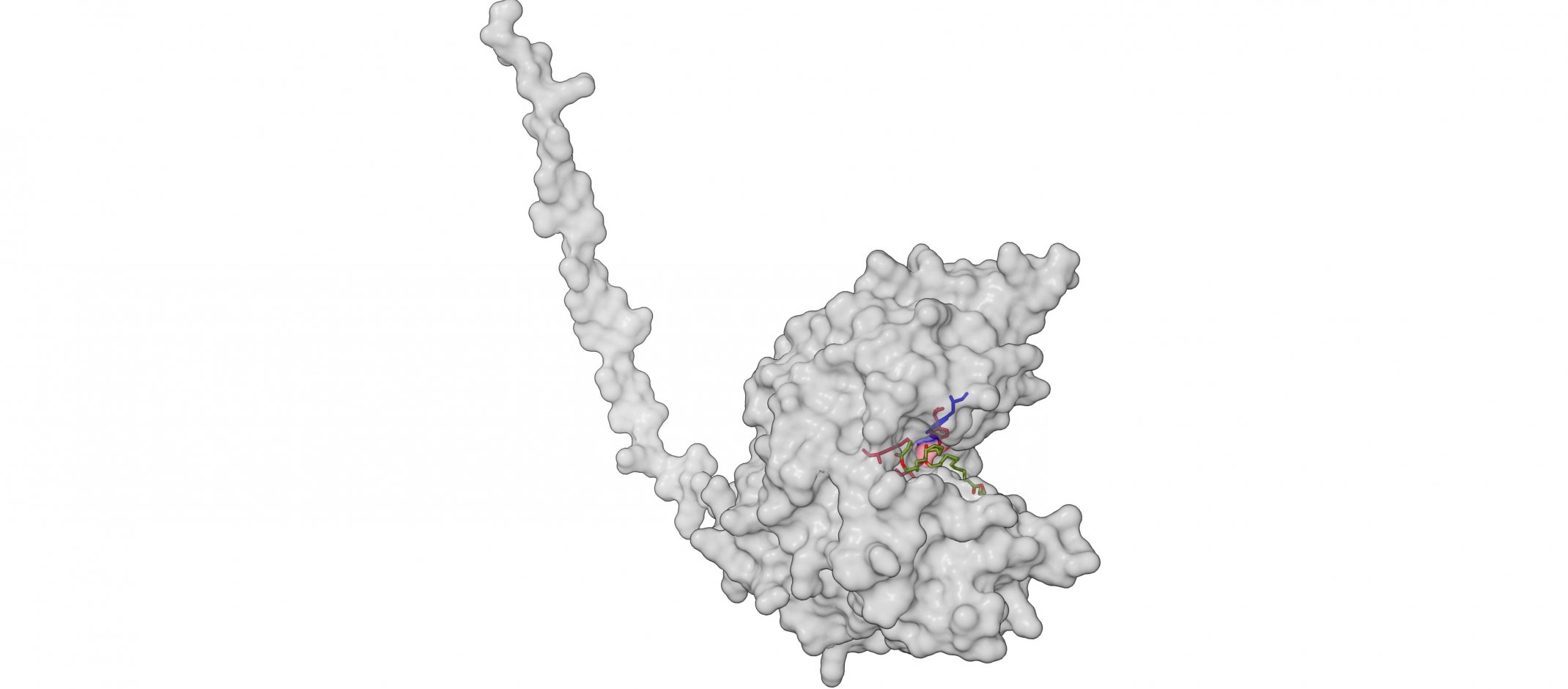
But that’s not all. The structural model of the newly discovered enzyme revealed yet another surprise: "The three-dimensional model of the enzyme revealed an active site that is unusually wide open – so much so that large and bulky substrates, such as polymer chains and penicillin, can bind particularly well and undergo hydrolysis", explains Lerner. "And because of the enzyme’s shape, but also because of its activities, we call it the ‘Pac‑Man enzyme’,” adds Schleheck with a laugh.
© The ISME Journal, DOI 10.1093/ismejo/wrag203, Creative Commons Attribution (CC BY) license, Figure 7 in the article, cropped to panels (a) and (b) onlyThe image shows a structural model of the recently discovered plastic depolymerase, modelled using AlphaFold3. It has a particularly wide-open active centre to which large substrates, such as polymer chains, can bind. Models of the substrates bound to the active centre (modelled using AutoDock 4) are shown on the right for the bioplastics PCL and LCAP (PE-12,12), and for the beta-lactam antibiotic ampicillin. To the far left of the structural model is a flexible tail to which the membrane anchor (lipid anchor) can be attached.

Cover image: The ISME Journal, DOI 10.1093/ismejo/wrag203, Creative Commons Attribution (CC BY) license, Figure 7 in the article, cropped to panels (a) and (b) only