Mass media of ancient times
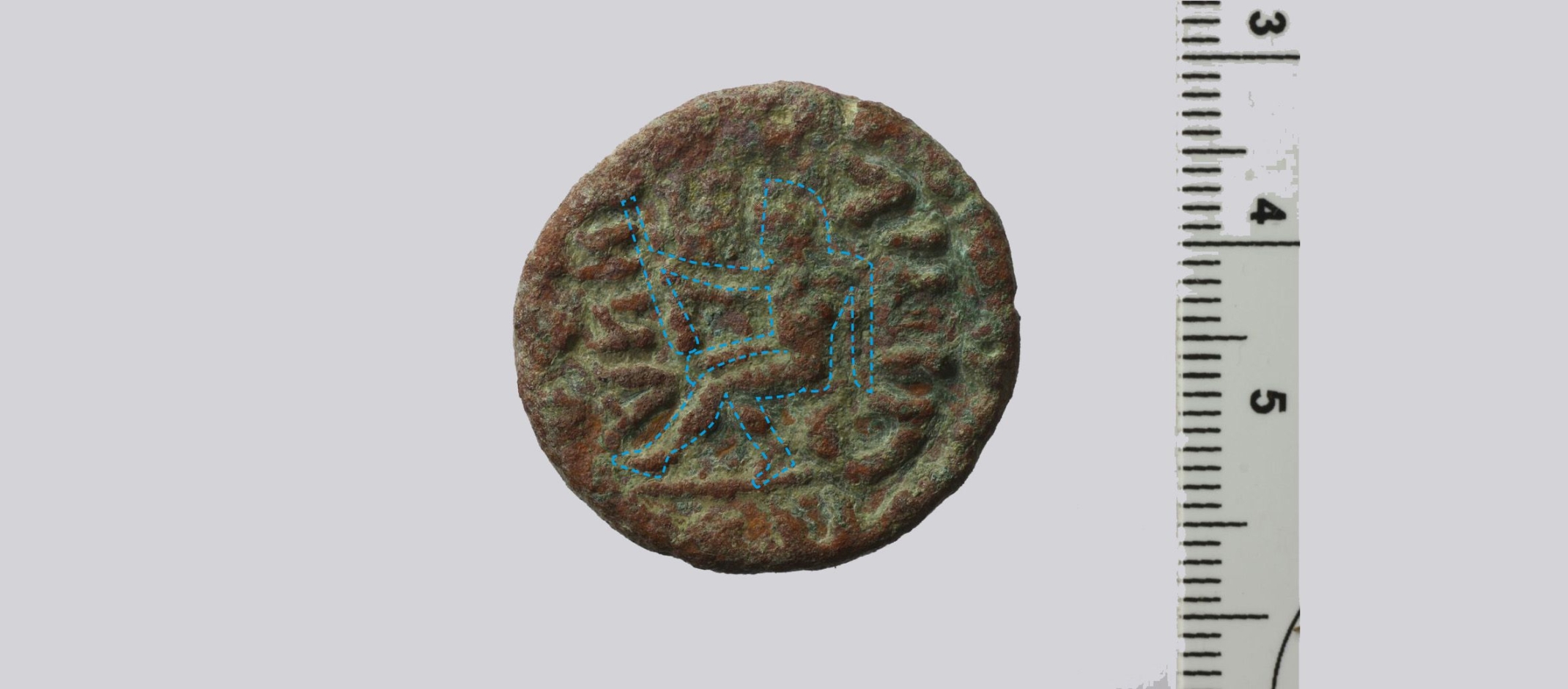
If you have ever visited an archaeological museum, you may remember seeing rows of coins from ancient times – made from different materials, during different periods and with different designs. For Stefan Hauser, a professor of ancient Mediterranean and Near Eastern archaeology at the University of Konstanz, each coin is a window into its own little world. In an interview, he explains what information he can derive from a coin. Take, for example, the ancient coin shown here from Alexandria on the Tigris.
Why are coins considered so important for archaeology
Stefan Hauser: At archaeological excavation sites, coins are particularly important because they are usually easy to date. Many of them are labelled with the year they were minted. This allows us to date the context for the items found at the site. Although finding a coin does not tell us that the context is exactly the year the coin was minted – it certainly can't be any older than this date. Accordingly, we archaeologists call this kind of dating terminus post quem.
In addition to this, coins are outstanding historical sources. For the kingdom of Mesene, from where this coin comes, in particular, we have very few written sources. With coins, however, at least we can reconstruct the succession of rulers.
Finding coins also allows us to reconstruct historical connections. For example, if we find coins from India in southern Iraq, then we can conclude that there had been trade connections with the people living there.
What role did coins play in ancient times?
Generally speaking, coins are not something that occur in nature or grow naturally. The minting process requires certain skills as well as agreement on the economic idea behind money, guaranteeing that a certain, generally accepted value is connected with it. Even in ancient times, coins were important for states, to promote trade and keep the economy running.
The pre-requisite for this guarantee was – and is – that groups of people agree to a controlled, generally applicable system of equivalence. At the same time, coins were truly the mass media of the ancient world – and thus suitable for conveying political messages. The design of each coin represents a particular form of government and a particular ruler.
Ancient Dynasties
In the mid-sixth century BC, the Persian Empire emerged as the largest empire in history up to that time, stretching from the Indus Valley to Macedonia and Libya. Its rulers belonged to the Achaemenid dynasty. Although Alexander the Great conquered the empire, he died soon afterwards in Babylon in 323 BC. Following his death, his generals divided the vast empire among themselves. Seleucus succeeded in conquering the territories stretching from Anatolia to the Indus Valley. From the mid-second century BC onward, however, his successors gradually lost control of the eastern regions to the Arsacid dynasty. Between 96 BC and AD 226, the Euphrates River formed the frontier between the empires of the Romans and the Arsacids. Then, the Arsacid dynasty was overthrown by the Sasanids.
How long have coins been around?
We know that, since the 3rd millennium BCE, precious metals had been used as units of measurement with specific weights in Mesopotamia and Egypt. The value of items, particularly of goods, was expressed as a multiple of specific measures of weight for precious metals. Coins are different, in that they bear markings which identify the issuing authority. The first known coins are from the 7th century BCE. They emerged in Lydia, in western Anatolia, and soon also in the coastal towns along the Phoenician and Ionian coasts, corresponding to present-day Lebanon and the western coast of Turkey. These regions, which prospered under the suzerainty of the Achaemenid Persian Empire, were important centres of trade. From there, the use of coinage spread throughout the Near East and across the Mediterranean world.
Starting in the 4th century BCE, coin denominations were calculated in terms of the drachma in regions under Greek influence. And then, under Alexander the Great, this expanded into the Middle East, too. The largest coin denomination was usually the tetradrachm, worth four drachmas. The coins were originally made of silver and weighed around 17 grams. The coin in the picture is a tetradrachm.
© Charax ProjectObverse of an ancient coin bearing the portrait of King Heracles. Copyright: Charax Project, hatching added by the University of Konstanz

Does the material value of the silver determine the value of the coin?
The question of this coin's "real" value is particularly fascinating because the tetradrachm is made of bronze, only purporting to be a silver coin. This is basically where we see a divergence between the real and nominal values of coins.
Time and again throughout history, we can see reduced amounts of silver in nominal silver coins. Historians are not sure about and do not entirely agree on what this means in concrete terms. It is usually interpreted as a sign of economic weakness in the corresponding regions. Yet, the fact that the bronze coins were clearly accepted as a means of payment begs the questions: What value was ascribed to them – the value of the silver? Or were they considered to be inferior coins?
What do you think?
Personally, I would argue that these tetradrachm coins were accepted as being equivalent to silver coins, although they were only made of bronze. This, in turn, would point to the high standing of the issuing institution guaranteeing the coin’s value independent of the value of its metal content.
What were the rulers like?
The front side of this coin shows King Abinergaos II, about whom very little is known beyond a small number of coins bearing his name. He ruled Mesene, a province of the Arsacid Empire, from approximately AD 165 to 180. At that time, Mesene encompassed the southernmost part of present-day Iraq and the western coast of the Persian Gulf, extending as far as Oman. Hierarchically, he was subordinate to the Arsacid ruler, who bore the title "King of Kings", as the most important provinces, including Mesene, were governed by kings. Abinergaos wears a diadem, a symbol of his royal status, and is depicted facing right. The reverse shows, as on all coins of Mesene, a seated Heracles (editor’s note: see title image), facing left. Coinage began in Mesene shortly after the region gained independence from the Seleucid Empire in 128 BC. Yet the coin presented here, minted some 300 years later, retains the same basic design: a royal portrait facing right on the obverse and a seated Heracles on the reverse. This remarkable continuity illustrates the enduring iconographic traditions of Mesene's coinage over several centuries.
Why does Heracles appear on the back side?
We actually don't know why this image of Heracles is on all Mesene coins. Yet the fact that it was always used indicates a very intensive connection between the ruling dynasty and Heracles. Hellenistic royal dynasties traditionally determined a particular deity that they identified with especially strongly. The Seleucids, for example, had an image of Apollo on the back side of all their coins. People probably also believed that Apollo was an ancestor of the Seleucids.
Where was this coin found?
The coin comes from the city Charax Spasinou, previously known as Alexandria on the Tigris. The city in what is now southern Iraq was founded in 324 BCE by Alexander the Great. For centuries, it was a hub for trade with India as well as the capital city of the Mesene province in the Arsacid empire.
© Charax Spasinou Project (Stuart Campbell 2017)Of the ancient city of Alexandria on the Tigris, only the surrounding rampart now rises above ground level.
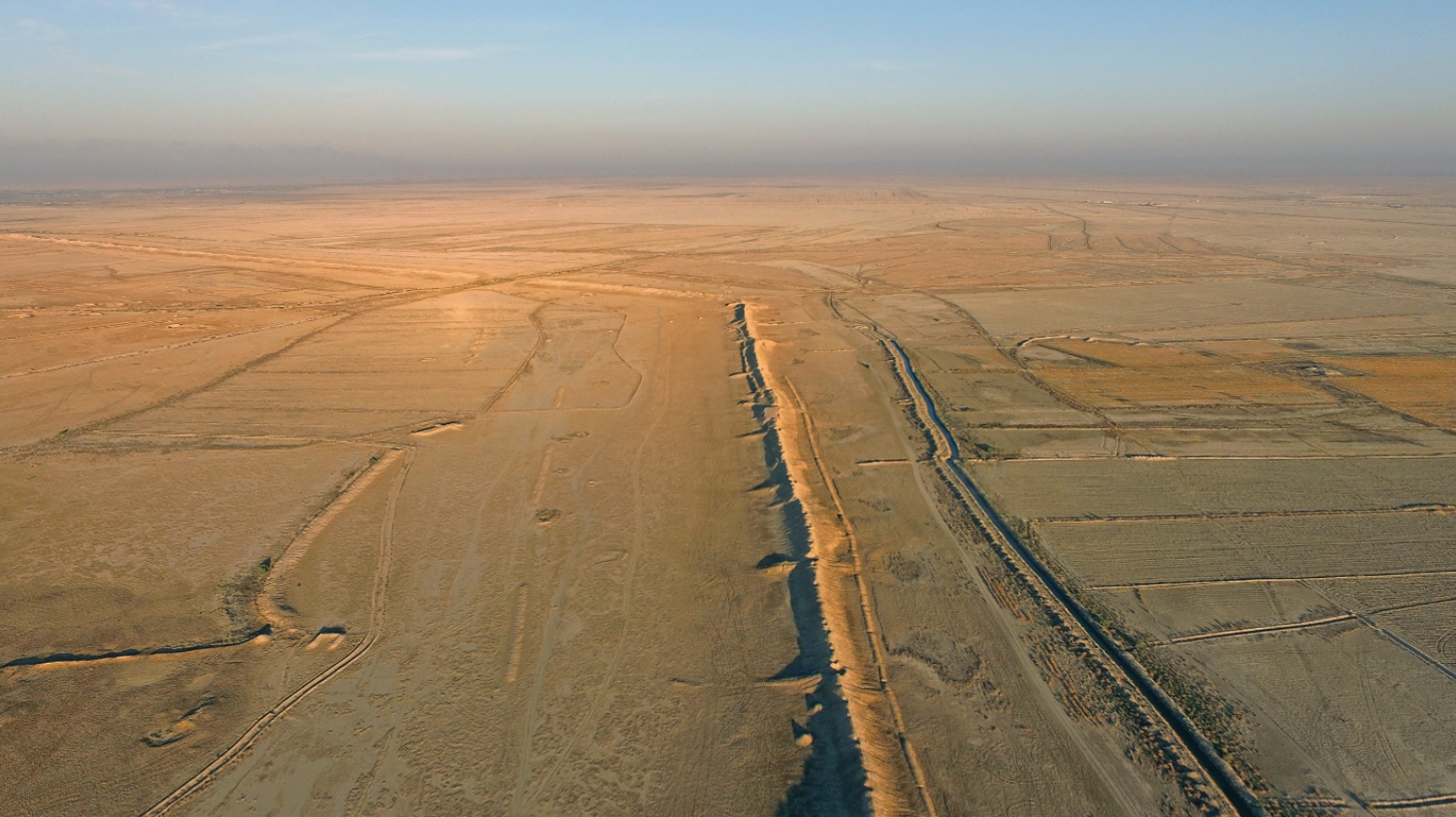
In flourishing trade centres like Charax Spasinou, we expect that there would have been a great flow of money passing through the area. When you visit the surface of the massive ruins today, you see highly corroded fragments of smaller coins everywhere. We actually wanted to be there right now, but the ruins are located near the border to Iran. Because of the war the US and Israel started on Iran, we are thus unable to continue our excavations as planned.
Stefan Hauser is currently working with Patrick Pasmans, a legal scholar and passionate Belgian numismatist, to catalogue as many of the Mesene coins as possible. At the moment, one of Hauser's students is completing his master’s thesis on the coins of the late 2nd and early 3rd century AD.
Title image: The reverse side of an ancient coin depicting Heracles seated. Copyright: Charax Spasinou Project, Photographier: Robert Killick, hatching added by the University of Konstanz