
A close-up look at the everyday practices of a public authority
"When people hear the word 'bureaucracy', most of them think of something boring – but, for me, bureaucratic administration is actually quite fascinating", says anthropologist Anna Louban. "This is because bureaucracies do not necessarily run as clearly and rationally as they often claim to. These are places where people work together – and where they interact with other people, too. And we know that, where there are people, there are also unexpected events, provisional solutions, workarounds and sometimes absurd resolutions." The realm between the bureaucratic aspiration of clarity and what actually happens is what the researcher was particularly interested in studying.
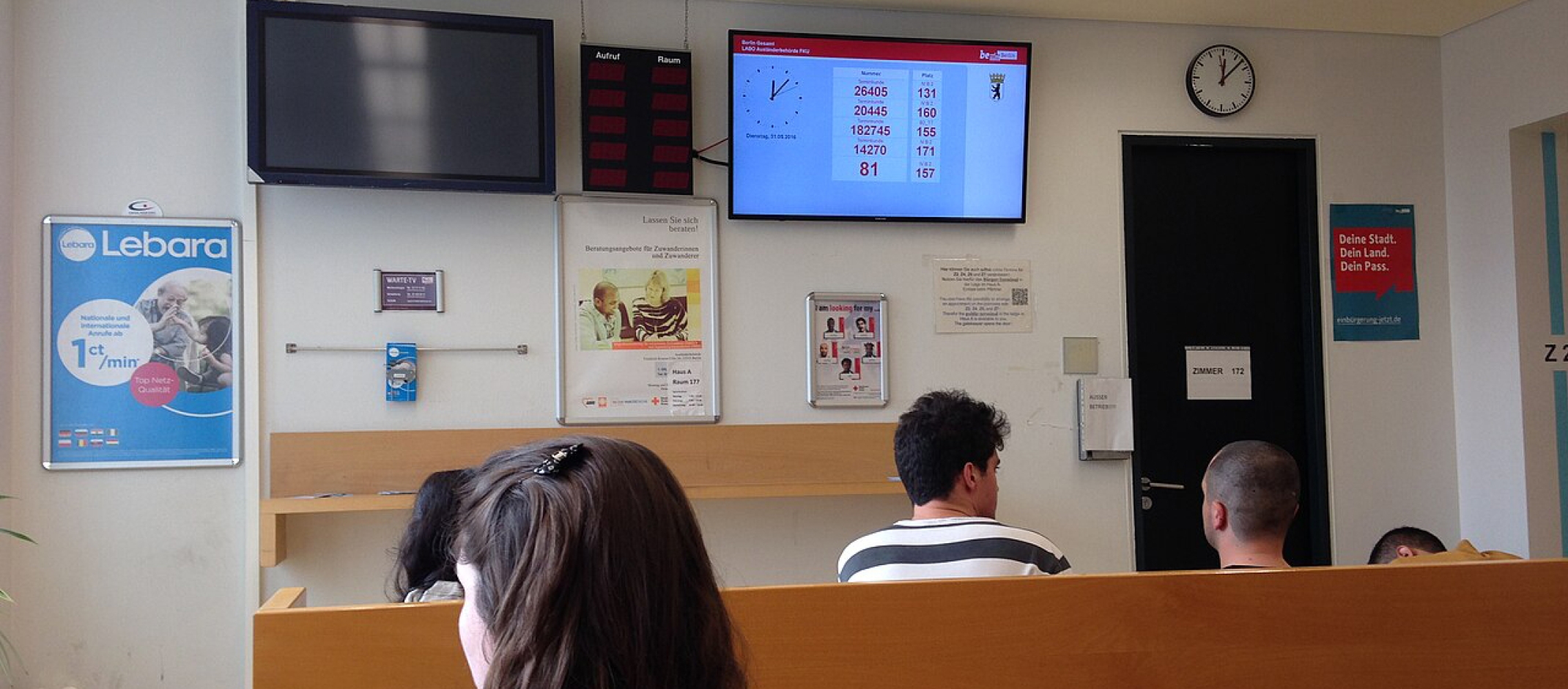
The location of the field research for her doctoral thesis: the foreigners registration office in Berlin. Here, in Germany's largest such public authority, she wanted to examine how staff and (im)migrants complete administrative processes. Which staff members act, and how do they act? Who responds how? How do people talk to each other and negotiate their perspectives? In the offices of the public authority, she not only studied the specific everyday practices of the staff but also the unintended and, as she says, "often unforeseeable consequences" for those involved.
"In today's media, migration is portrayed as being something large, threatening and chaotic", the anthropologist says, "but at the end of the day, migrants are people just like you and me, who would like to work or study, get married and start families. However, since they do not have German citizenship, they have to submit applications to the foreigners registration office in order to live in Germany while doing these things."
Dr Anna Louban
Immigration authorities regulate borders and people, often in cases where the respective people are already in the country. This is what makes (im)migration bureaucracy – the title of Louban's dissertation – so special. And the "clients", as they are referred to in this context, come from different administrative structures, are accustomed to other bureaucratic practices and possess different types of documents. Louban saw the anthropological method of "participant observation" as the most suitable for her research. She conducted her field work at three central institutions of the migration bureaucracy in Germany: the foreigners registration office, the integration courses and the naturalization office.
A critical moment for the field study
For anthropologists, conducting field work means being on site to participate in situations and at the same time observe interactions and processes for a long time. Researchers either record or take notes on the conversations before writing down and reflecting on the observations in their "field diary". "At the start of this kind of project you only have a basic idea of where 'the field' will be located, what 'it' actually will be", the anthropologist says. "So you pick a topic, read up on the research literature and compose a research concept. And then it's time to find access to the field."
Finding access means getting into contact with a person who is already part of this field. The field is defined as a "place where there are people". Sometimes, as Louban did, researchers gain access to a field by making a formal written request; in other cases, the process is more informal – by contacting people on a personal level. Anna Louban emailed an official request to the Berlin immigration office – but would the authority be open to offer the kind of access required for anthropological research?
The researcher emphasizes, "I was really surprised when, a few days later, I found myself in a phone call with the head of the immigration authority himself. I was invited to present my research project at the leading team of the authority. From the start, they informed me that this was not an agreement but rather an opportunity to gather more information and see what I had to say."
Louban remembers well how she presented her project idea to the authority's committee. "For example, there was a lady wearing a grey pantsuit across from me who kept her arms firmly crossed as I very nervously made my presentation. Later, this woman told me that, before the meeting, she had very much intended to vote against the project." But that is not what happened: This leading staff member became the main contact and an appreciated discussion partner for the researcher's project.
"The authorities recognized that someone was willing to devote time and interest into looking at the situation from an outside perspective – and that they themselves could benefit from this perspective. This is why I was granted access to the field", Anna Louban emphasizes. At first, she faced very strict limitations about when she could come as well as the requirements for when she was allowed to be present while civil servants interacted with their "clients". However, after just a few days of the shared research experience, these restrictions were relaxed. "They saw how my field research took place and that it did not disrupt their work or intend to meddle by pretending to know better", Louban explains. Her aim was to be present at those interactions, and to gather the staff's perspective as well as the clients' thoughts on their interactions with the German authorities, and to understand precisely what took place at this office.
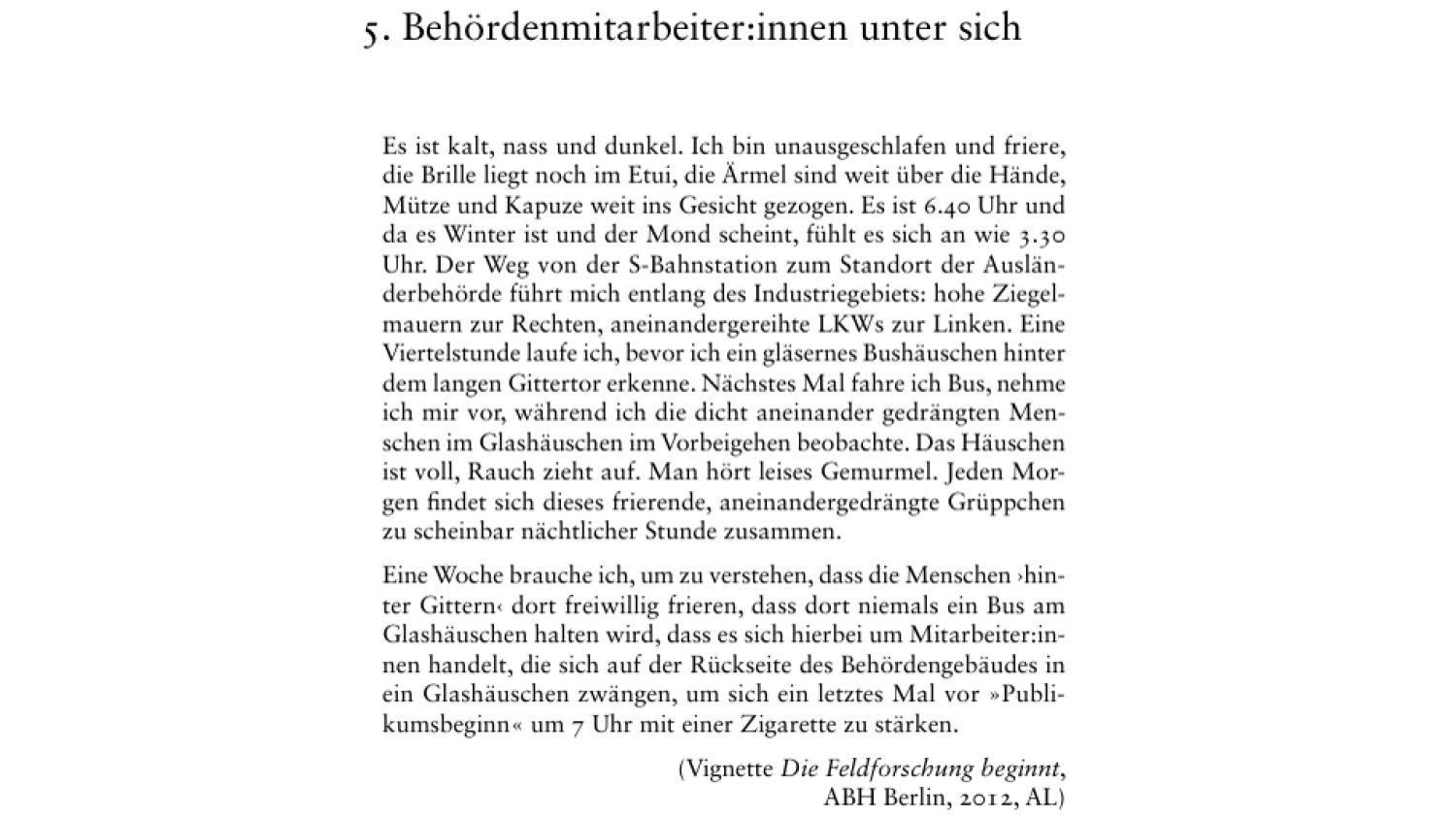
Excerpt from the book
With a notepad and recording device
Of course, the clients from all over the world were also asked ahead of time whether they would permit Louban to be present for conversations about their administrative matters. After all, the applications involve issues that are important and sometimes even existential – such as whether they can start working or studying and/or whether they can live their marital life in Germany on the legal basis of a marriage to a German or a foreigner with a stable resident status. In short, the decisions involve whether people can shift their main residence to Germany or continue to live their lives in the country.
"In reality, many more people are involved in the meeting and there is a lot more interaction taking place."
Anna Louban
Anna Louban hat originally imagined these kinds of conversations to be much more isolated, with just the staff member(s) and respective migrant(s) – two or three people – at the table. She realized, however, that "in reality, many more people are involved in the meeting and there is a lot more interaction taking place." Consider, for example, the high level of noise in the offices with open doors connecting to a corridor. And staff working with clients, who do not only each meet separately with their own clients, but in fact can work together, getting involved when they feel it is helpful.
The contrast between perception and reality
After finishing the observations, it was time to bring together the written records of the many conversations and explanations of the people acting "in the field", all the fieldnotes and sketches, to get the overall perspective and reflect upon the events. In the context of a dissertation, anthropological field work can last up to one and a half years, resulting in a large amount of material which needs to be examined from different perspectives. For example, Louban realized the strong power of narratives among staff members: "There is the narrative that meetings with migrants are stressful and tend to be unpleasant." However, she personally observed a high number of positive encounters. One time, after a relaxed and successful meeting, a staff member closed the door and said to her: "You know, that was actually a really nice client. He wished us a happy new year before we looked into his application." The staff member then went on to list a few more positive aspects of what went particularly well in the meeting with this client.
Louban says: "This caught my attention, as I had, in fact, observed many positive interactions. And, in my notes, I found that it had actually been another client who had wished the staff member a happy new year. And other positive things she mentioned had been part of meetings with other clients. All of these impressions were then summarized into a statement of an exceptional case," the anthropologist explains the "process" and underscores that these insights are the kind of thing you cannot read about in a book or policy paper – you have to experience them in person through participatory observation.
Collection of notes by Anna Louban

At the same time, she emphasizes how seriously the staff take their responsibilities, sometimes even in the face of effectively impossible tasks: "If we ask staff at a public authority to investigate something, then they will do that – regardless of how useful or doable this task actually is." Take, for example, the task of examining whether a marriage only exists on paper: Staff are supposed to assess the authenticity of a couple's relationship beyond the facts stated in the bureaucratic document of a marriage certificate. "However, it is impossible for anyone besides the spouses to know whether there is a genuine social connection between them. Staff can only check the documents but not the authenticity of a couple's relationship. Yet, because they have been asked to do so, civil servants have developed practices to somehow fulfil this obligation to investigate, anyway."
Anna Louban published the results of her research on German (im)migration bureaucracy in her 2026 dissertation entitled "Deutsche Migrationsbürokratie: Akteur:innen, Praktiken, rechtliche Regelungen und die (un)intendierten Konsequenzen institutioneller Dynamiken". The book is freely available for download on the publisher's website. Louban's project took place in the working group led by Thomas Kirsch, professor of social and cultural anthropology at the University of Konstanz, and it was funded from 2012 to 2018 in the context of the then Cluster of Excellence "Cultural Foundations of Social Integration" at the University of Konstanz. Looking back, Louban says, "My project strongly benefitted from being part of the very interdisciplinary research network at the University of Konstanz. There were many different formats for exchange, and I really profited from the knowledge other fields had to offer."
In her book, Anna Louban describes how civil servants base their assessments on concepts and experiences from their own lives: What is a "true" story of how a couple met? What is an acceptable birthday gift? How much time does a "real" couple spend together, and how? Do the answers fit the kinds of relationships that staff members are familiar with? And, above all: Do both spouses give the same answers? The answers to these questions help form the basis for deciding on the authenticity of a bilateral marriage – and family members are only permitted to move to Germany in the case of a "real" marriage.
Header image: Waiting room of the foreigners' registration office in Berlin. © Creative Commons CC0 1.0 Universal Public Domain Dedication. User: Renatotcm, Link
