
In tact: How military music developed during the 19th century
We have all seen the scenes on the news: An important government leader is welcomed to a country, everyone shakes hands with great formality, and both countries' anthems are played for the occasion – by a military band. And even though the location varies – from Berlin, Washington D.C and Tokyo to Cairo and beyond – the music sounds very similar every time. Why is that?
"The emergence of modern military music in the 19th century is closely tied to colonialism and the nation-building process", explains historian Martin Rempe who studies global music history among other things. And Western experts in military music, too, where commissioned to write national anthems, such as Alfred Lemaire (from France), who wrote the Persian anthem, and naval bandmaster Franz Eckert (from Germany), who wrote the Japanese anthem.

"As many countries of the world established their own military bands, they hired professional military musicians from the West. It was viewed as a symbol of modern statehood to have one's own military music, based on the Western model".
Martin Rempe
The fact that the anthems sound so good musically when they are played to welcome state representatives is the result of another development that, at first, mainly took place in Europe. Up until the French Revolution, military music primarily served military purposes, such as accompanying marches and giving signals, in addition to fulfilling state and courtly tasks. During the extended 19th century – the period from the French Revolution until the first World War – the training of military musicians was finally professionalized, and the construction of musical instruments developed further.
First universities to train musicians
In 1795, the world's first music conservatory, the "Conservatoire de musique", was founded in Paris. It was the product of a smaller military music school, started by a revolutionary named Bernard Sarette, and a royal school of singing. Today, it is considered the first higher education institute for musicians – a place that first trained the Republican and later the Napoleonic army's musicians.
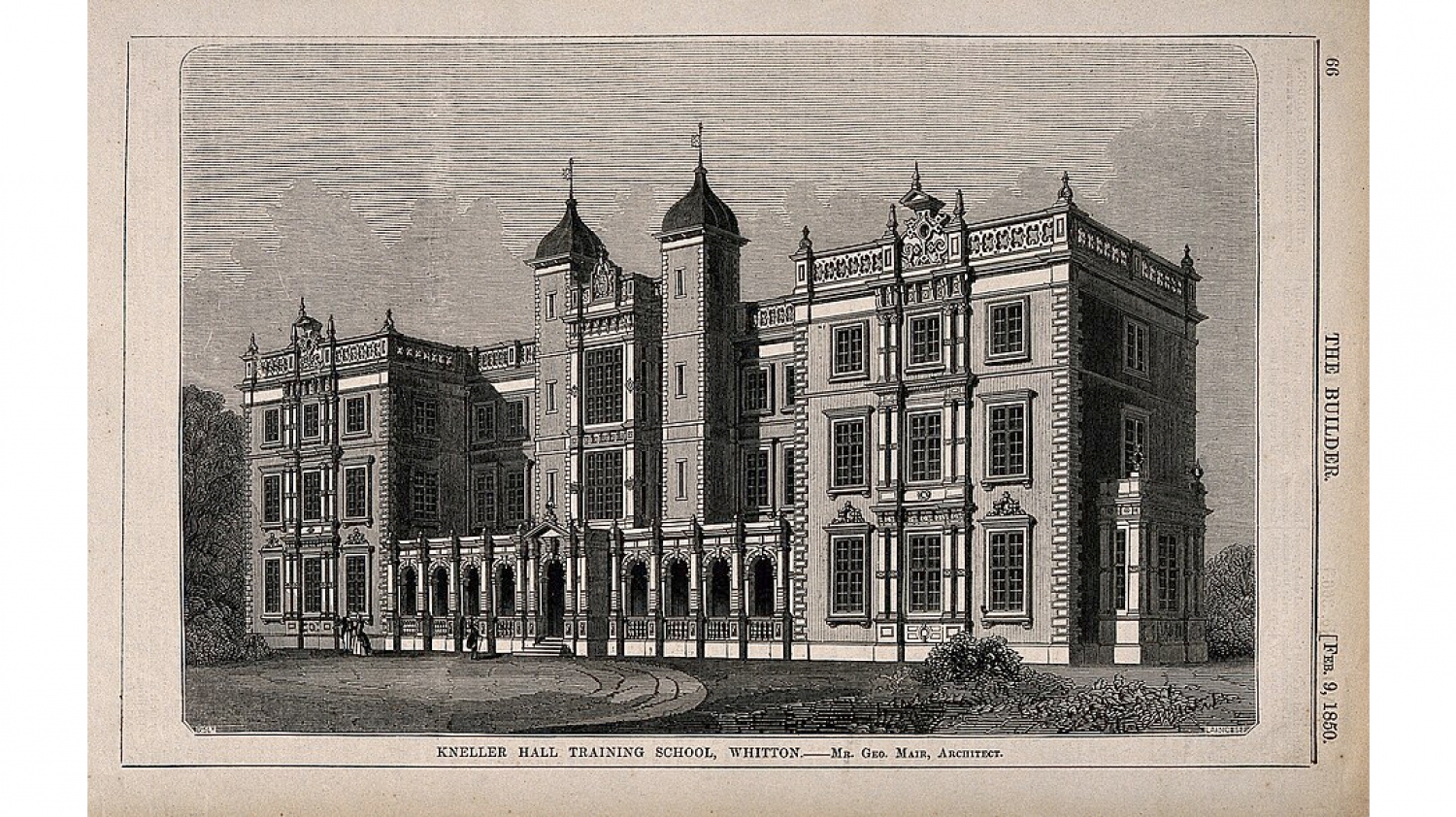
Later, other such institutions were founded in European metropolises, such as the Royal Military School of Music at Kneller Hall in London. These places were specifically established to train military musicians. "How Kneller Hall came about is quite a funny story", Rempe explains. "During the Crimean War, there was a huge public embarrassment. For Queen Victoria's birthday, different British military bands were supposed to perform together. Word is, that it must have sounded abominable – an absolute cacophony. Afterwards, everyone agreed: Something simply must be done about this. And so, Great Britain's first professional training institution for musicians was founded, at Kneller Hall, to provide systematic training for British military musicians."
© Creative Commons Attribution only licence CC BY 4.0, http://creativecommons.org/licenses/by/4.0/Kneller Hall Training School, Whitton, Middlesex. Wood engraving by C. D. Laing, 1850, after B. Sly after G. Mair.
Modernization of arrangements, new instruments
In turn, a few military music reformers gave the impulses for the artistic professionalization of military music. For example, civilian orchestral musician Wilhelm Wieprecht, joined the army where he then modernized Prussian military music. With great enthusiasm and diligence, he determined the musicians and instrumentation, introduced new instruments and wrote numerous arrangements. Not only did he use an extraordinarily large number of musicians in his military band, but he also fought to improve their social standing. Rempe says that Wieprecht is considered to be the father of modern Prussian military music – through his work as a composer, conductor and arranger.
With regard to the development of instruments, too, the 19th century took a great step forward. A valve was invented for brass instruments such as the trumpet and the horn, which made them easier to play and especially improved harmonization while playing together. Rempe explains:
"This enabled an increasing number of musicians to perform together in harmony. And larger groups of musicians were able to represent their countries in a much more powerful way."
Martin Rempe
Prestige was also a major part of the "monster concerts" held by Wieprecht and others. For the concerts, he brought together several military bands from Berlin – for example, to perform for the czar's visit to the city in 1838. More than 400 military musicians played simultaneously for the occasion. "That actually must have sounded horrible", says music historian Rempe, "but these 'monster concerts' were hugely popular and spread quickly across Europe and beyond."
The 19th century "record"
A multi-ethnic state such as the Habsburg Empire had a vast number of military bands, particularly in the non-German-speaking provinces. In addition to enhancing the prestige of the monarchy and the empire, they also served to promote integration. "One of the main goals was to inspire people's enthusiasm for the monarchy and the German nation-state. Military bands thus became a matter of national prestige", Rempe explains.
The military bands' job was to entertain the public and foster patriotism among listeners in order to increase their connection to the nation-state".
Martin Rempe
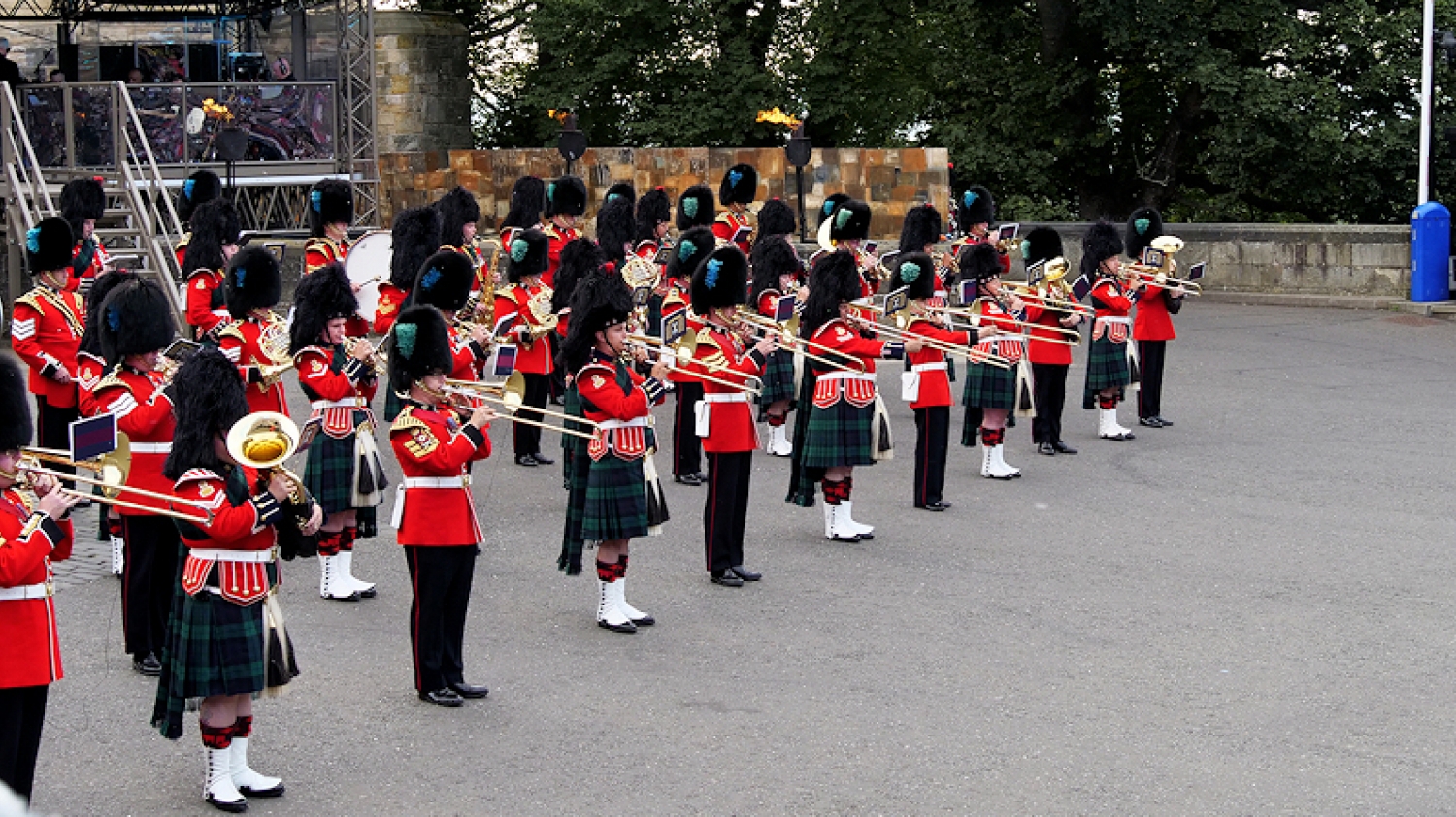
© David Dixon, CC BY-SA 2.0, via Wikimedia Commons
To this end, the bands also started to play pieces that the local population was already familiar with. This is why military strategists allowed their bands to perform publicly. "There really was no cheaper way to inspire people to support the monarchy and the empire", Rempe says. "Civilian musicians, however, feared that competition from military musicians would take away their jobs". Accordingly, a great deal of money was invested in establishing military bands: Between 1871 and 1914, for example, the total number of military bands in Germany increased from 350 to 600. This shows the high significance of military music towards the end of the 19th century – and the same development took place in France and Great Britain, as well.
What music streaming services such as Spotify or Apple Music are today, and records, cassette tapes and CDs were in the 20th century, the military bands were to the 19th century. This musical information was practically everywhere – the bands performed in concert halls, parks, beer gardens and public spaces. Their repertoires were incredibly wide-ranging: Military musicians could play just about anything, from different genres, including marches, dance music, folk music and classical music – such as symphonies or excerpts from operas. They met people's demand for music, especially in rural provinces where there were fewer musical events than in places like Berlin or Leipzig. "Performances by these bands were often the only places where people came into contact with music", the music historian emphasizes.
The great significance of military music can even be seen today, in Konstanz: In a somewhat hidden spot in the Stadtgarten park, there is a bust of Konstantin Handloser. In the 1870s, he led Konstanz's military band – at a time when Konstanz only had about 13,000 residents. As a talented musician and conductor, he managed to quickly shape the band into a fine ensemble. The band rapidly developed into the most important musical group in town, whereas, until then, the population had had hardly any access to musical entertainment. Starting in 1875 at the local Inselhotel, Handloser and his band started to give symphony concerts. Afterwards, the band became a fixture in Konstanz, performing series of symphony concerts as well as popular concerts in the Stadtgarten. The excellent reputation of the Konstanz military band soon spread internationally, and Handloser and his musicians also went on tour in Switzerland.
Repertoires from classical to popular music
Like Konstantin Handloser, most German – as well as French and British – military bandmasters were focused on the art of making music. Around 1900, there really was no clear distinction between "serious" and "entertaining" music, or between military music and civilian musical culture. Rempe says there was a lot of interaction between the genres. And some composers, too, recognized that military bands played a significant role in making pieces of music and musical genres popular. It was especially important for these composers to have their music heard and for it to be popular.
https://youtu.be/T91MLcrnx_0?si=YLqMPkQ8WRUXPq-S
For example, Richard Wagner explicitly sought contact with military musicians, so that they could write arrangements of his operas and perform them for the public. To this end, he remained in close contact with the Prussian military bandmaster Wilhelm Wieprecht and constantly praised his arrangements. In the case of two of his operas, "Lohengrin" and "Tristan and Isolde", there is even evidence that Wagner had military bands perform excerpts for audiences, as a sort of sneak preview. This means, before "Lohengrin" even premiered, individual passages had already been performed by military bands.
Military music experts as "cultural brokers" in the colonies
Returning to the colonies mentioned previously: It was not only the case that military music experts influenced the music of colonizing countries. The local musical traditions of colonized countries were also strongly influenced by them. For example, the Prussian military musician Heinrich Berger was selected for an expert mission to Hawaii. Since he really enjoyed living in Hawaii, he settled there permanently. As the leader of the local military band, he got to know Hawaiian melodies, wrote many arrangements and incorporated numerous elements of this tradition into his own compositions. In addition to this, he trained many local musicians. This way, Berger had a significant influence on modern Hawaiian popular music and is still regarded today as the "Father of Hawaiian Music".
Since 2011, historian Martin Rempe has researched and taught at the University of Konstanz on the topic of of German, European and African history of the 19th and 20th centuries. He currently receives funding through the Heisenberg Programme of the German Research Foundation (DFG). Rempe's habilitation thesis "Kunst. Spiel. Arbeit. Musikerleben in Deutschland, 1850 bis 1960" (Vandenhoeck & Ruprecht, 2020) focuses on the work and lives of musicians in Germany. The English translation, "Art, Play, Labour: the Music Profession in Germany (1850-1960)", was published open access in 2023.
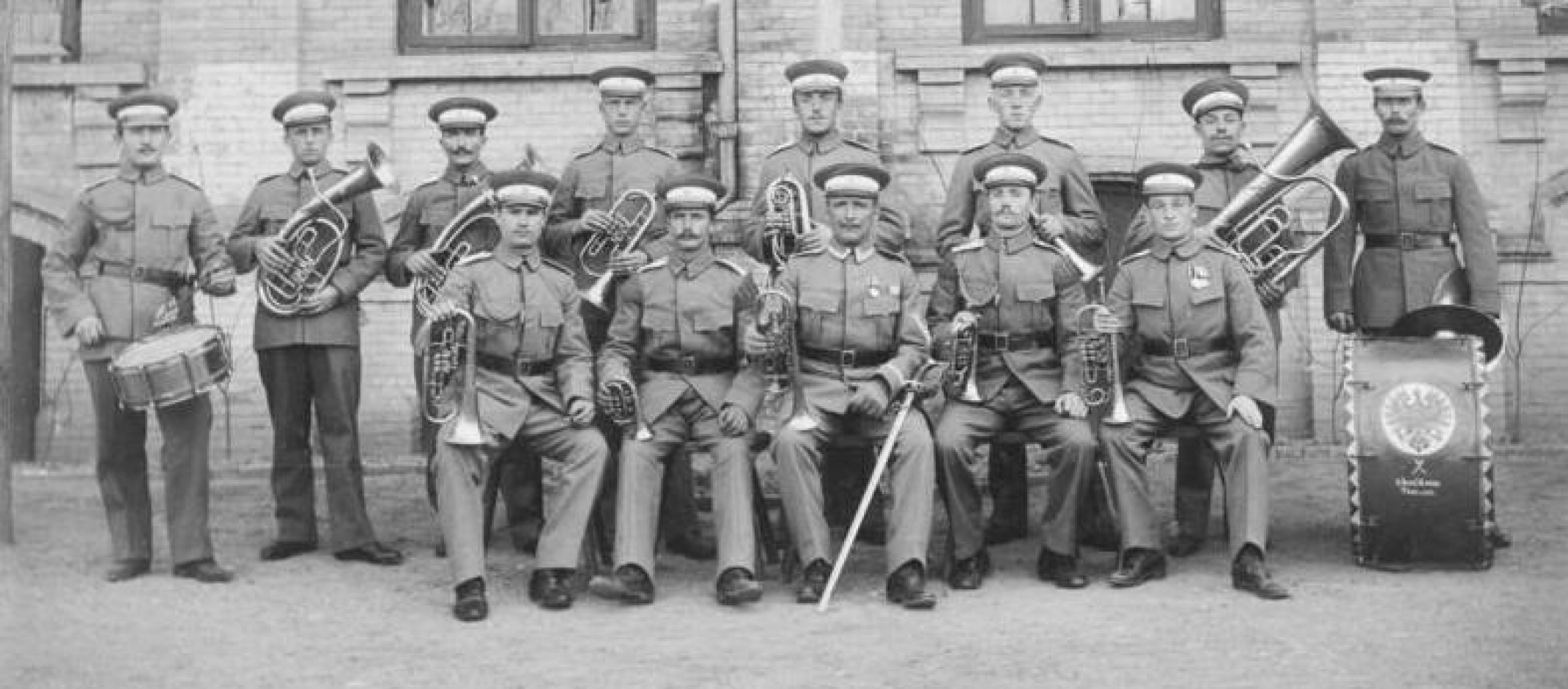
Cover photo: German military musicians in Tientsin, China, in 1898. Federal Archives, Image 116-127-009 / CC-BY-SA 3.0, CC BY-SA 3.0 DE, via Wikimedia Commons. The image has been cropped. Link to the original image
