
With dedication, support and a good measure of persistence

Dowry sounds like an old-fashioned term. Isn’t it something that, at least in our part of the world, we associate with marriages several decades ago? A dowry is a form of financial support provided by the bride’s family, either to the groom’s family or directly to the newly married couple. Although the practice largely disappeared from Western societies during the 20th century, it remains an important tradition in emerging economies such as India. This is concerning because many girls are still married off at a young age. "Child marriage remains widespread in India and places a particularly heavy burden on very young girls", explains Pascal Mounchid, a master's student in Politics and Public Administration at the University of Konstanz. "Among its many consequences, this cultural practice shifts the perception of girls from children or adolescents to economic assets, treating them as commodities that can effectively be bought or sold to improve a family’s overall financial standing".
Mounchid explored the topic of child marriage in a term paper he wrote as part of the "Development and Conflict" seminar. In his research, he examined how the coronavirus pandemic had affected the number of child marriages in India. He compared the figures to another country, Zambia. There, instead of a dowry, the bride’s family demands a bride price – a payment from the groom’s family that traditionally compensates for the loss of the daughter’s labour. "The term paper was supervised by the seminar leaders, Lena Hönig and Prisca Jöst. However, its subsequent development into a journal article was made possible by the guidance of Janina Steinert, a professor of global health at the Technical University of Munich," emphasizes Mounchid, who was working as a student assistant with Steinert. "What helped me most was that Janina Steinert shared her experience of fieldwork in India and Zambia and gave me access to the primary data".
Applying scientific methods
The researchers were able to draw on descriptive statistics covering around 4,600 young girls, some of them minors, in the two countries: 3,000 in India and 1,600 in Zambia. These data had been collected as part of a parallel research project led by Steinert. In addition, local partner organizations conducted qualitative interviews. The aim was to find out whether the number of child marriages had risen or fallen in the wake of the coronavirus pandemic. In interpreting the statistical data, the researchers took into account the girls’ average age as well as their parents’ socioeconomic background, including household income, parental education and other key factors. Using a multivariate regression model, the researchers investigated the relationship between economic strain, the impacts of the pandemic and cultural norms. Regression is a statistical estimation model that describes the relationship between different variables.
"In India, we had expected the number of marriages to have fallen. Traditionally, the bride’s family pays a dowry and covers the costs of the wedding. We thought that if the bride’s family were facing financial hardship because of the coronavirus, they would wait before marrying off their daughters". In the case of Zambia, however, the research team had expected the opposite: In Zambia, the bride’s family receives a bride price. In the context of the pandemic, we expected to see a rise in child marriages in Zambia, as the bride price meant that marrying off a daughter could provide families with additional income."
Pascal Mounchid
Results defy expectations
The research team waited with anticipation to see what the statistical data and qualitative interviews would reveal. "We were completely surprised", Mounchid says, "none of our assumptions proved correct. In fact, we had to discard all of our hypotheses".
This was because dowry demands in India suddenly declined during the pandemic. At the same time, lockdown restrictions made weddings significantly less expensive. "Instead of the expected decline in wedding celebrations, India saw an increase in marriages. Parents were able to marry off their daughters at a much lower cost, especially since the large-scale weddings with 200 or more guests could no longer take place. A celebration with only 20 guests is significantly cheaper", explains the researcher. However, this also meant that the proportion of girls who were married while still underage rose from 6.5 percent to just over 11 percent. "Among underage brides, nearly one in five reported that they had been married off at an even younger age than was typical before the pandemic", Mounchid adds. "In many cases the girls had to leave their parental home and move in with the groom’s family at the age of 15 instead of 16".
The data from Zambia likewise failed to confirm the expected outcome, namely a rise in child marriages. There, the families of prospective grooms, who were expected to pay the bride price, experienced financial constraints during the pandemic. As a result, there was less incentive for them to proceed with marriage arrangements at that time. Mounchid comments: "In Zambia, too, the coronavirus had completely changed the economic situation. One explanation could be that the hardship affected everyone, including the grooms’ families". That did not, however, lead to a sharp decline in the number of marriages. In the interviews, girls and mothers cited other reasons for getting married at that time: The schools were closed, there was no money for school fees and the prospect of obtaining a degree vanished. "I’d stopped thinking about school", said one girl during the group discussion.
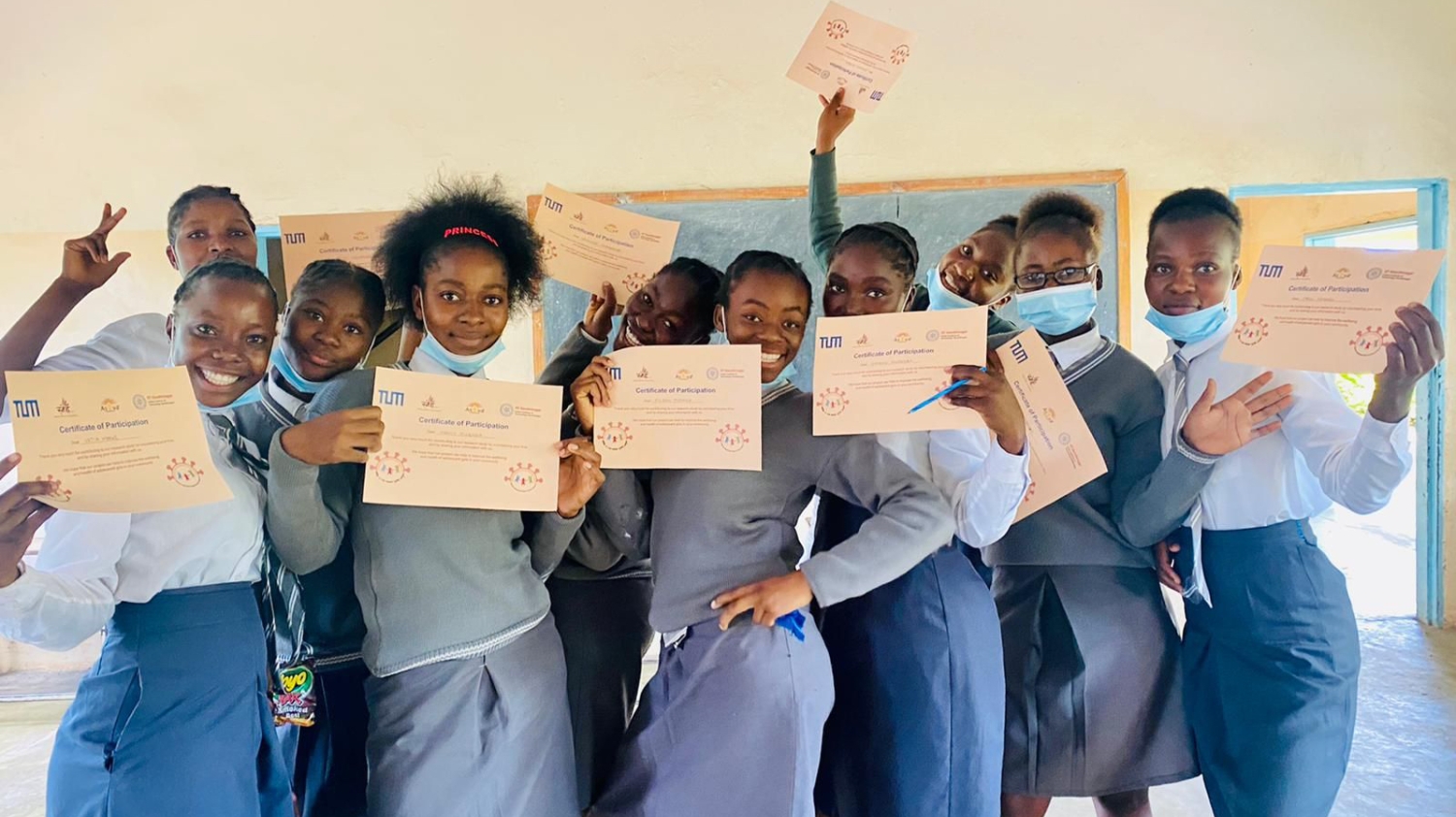
© Professor Janina Isabel Steinert, Professorship for Global Health, Technical University of MunichInterview group in Zambia
From term paper to publication
The results were so compelling that the team decided to turn the term paper into a publication. They subsequently conducted a data analysis that went beyond the scope of the seminar paper. In addition, they incorporated components commonly found in political science publications, such as a discussion of the results. Covering everything from outlining the significance of the research topic to presenting conclusions based on the findings, the submitted manuscript was approximately 5,000 words longer than the original term paper.
The team’s first submission to the scientific journal World Development was unsuccessful. A subsequent submission to Journal of Development Studies progressed to the peer-review stage, but was ultimately turned down as well. The journals justified their decisions by arguing that child marriage has already been researched extensively or that the paper was not sufficiently aligned with their disciplinary scope. By then, ten months had passed.
"Even though Janina Steinert had warned me that a peer-review process does not automatically lead to acceptance and that we would have to persevere and fight a bit, those two rejections were still deeply disappointing."
Pascal Mounchid
All good things come in threes
On 26 August 2025, the researchers made a third attempt, submitting their paper to PLOS ONE, a renowned interdisciplinary journal. The new reviewers had a few minor points of criticism, which the team addressed, as Mounchid explains: "It was a truly wonderful experience working with the reviewers, who gave us valuable advice and were ultimately very impressed with the revised version".
On 4 May 2026, the team finally received the news: Their paper would be published within a month. "You receive a very long email from the journal and immediately wonder, ‘Oh, what now?’ Then, buried somewhere in the middle, you finally come across the sentence that matters: ’Your paper has been accepted‘. I was absolutely thrilled", the master’s student says.
Read the article "The interplay of economic shocks and cultural practices in child marriage: Comparative evidence from India and Zambia during the COVID-19 pandemic", written by Pascal Mounchid (first author), Shruti Shukla and Janina Steinert at: https://journals.plos.org/plosone/article?id=10.1371/journal.pone.0346851